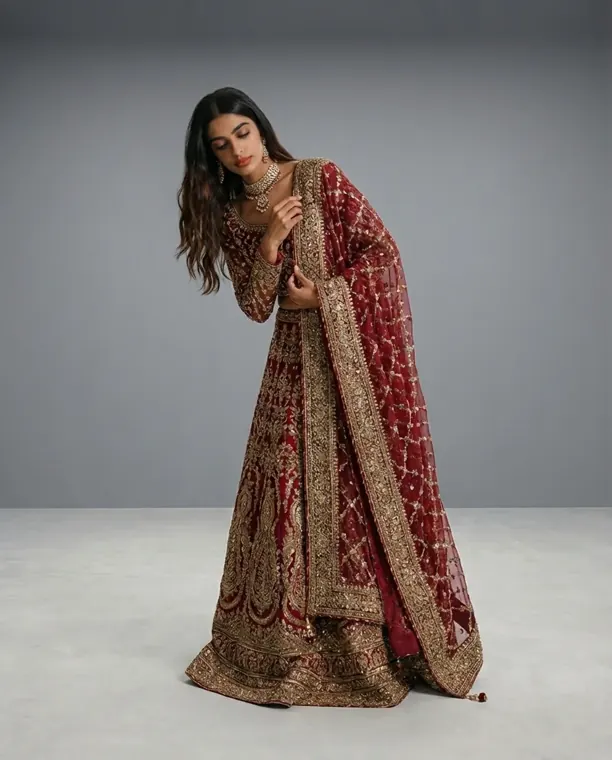
Short answer: AI models are faster and more flexible for catalogs, new drops and ad testing. Real models are still the better choice for brand-ambassador campaigns, live events and content where a real person's story matters. Most Pakistani fashion brands get the best results by using both.
The problem with catalog shoots
A typical Pakistani clothing brand launches several drops a season: lawn, pret, festive, formal, bridal. Each drop needs on-model images for the website, Instagram, Daraz and ads. With real models that means coordinating a photographer, studio or location, model fees, hair and makeup, steaming and styling, and then days of editing. If a piece arrives late or a print sells out, the plan changes and some of that work is wasted.
AI fashion models remove most of the scheduling. Once the garment is photographed clearly, it can be shown on a model in any pose, setting or light. That is why the question is no longer whether AI models are possible, but where they make sense.
Side-by-side comparison
| Real model shoot | AI model shoot | |
|---|---|---|
| Speed | Days to weeks, including booking and editing | Usually 24–72 hours from garment photos |
| Locations | Limited by budget, permits and weather | Any setting: haveli, marble hall, garden, studio |
| Consistency | Hard to repeat the same look months later | Same face, pose and light across every collection |
| Changes | Reshoot | Regenerate the frame |
| Authenticity | A real person customers may recognise | Photoreal, but not a real person |
| Best for | Ambassador campaigns, events, behind the scenes | Catalogs, new drops, ad testing, social content |
Accuracy: the make-or-break issue
Pakistani fashion is detail-heavy. Embroidery, gota work, block prints, borders and the drape of a dupatta are what customers pay for. Generic AI tools can blur these details, change the print or "improve" the design. If the customer receives something different from the photo, returns go up and trust goes down.
So the real comparison is not AI versus human but checked versus unchecked. At NAZAR every AI frame is compared with the original garment, and frames that change the print, colour or length are regenerated or retouched. If a studio cannot explain its accuracy checks, do not use it for product images.
What about customer trust?
Customers care most about two things: does the outfit look good, and will it look like this when it arrives? Accurate AI imagery meets both. Some brands choose to be open that they use AI models, especially when the model becomes a recognisable brand face, and this can become part of the brand story. Our own house models, Maria and Alia, are presented openly as AI.
Check the current rules of the platforms you advertise on, as Meta and TikTok have policies on labelling AI-generated content in some ad types.
A practical hybrid plan
- One real shoot per season for the hero campaign or a brand ambassador.
- AI virtual try-on for every SKU on the website and Daraz. How virtual try-on works.
- AI model editorials for Instagram, lookbooks and launch posts. AI fashion model shoots.
- AI video ads built from the same images, so ads can be refreshed every week. AI video ads.
This keeps the authenticity of a real shoot where it matters and removes the bottleneck everywhere else. For a real example, see how we turned five flat listings into a full campaign for Dia by Nadia.
Frequently asked questions
Can AI models wear shalwar kameez and bridal outfits?
Yes. Traditional and bridal wear need careful direction for the dupatta, embroidery and borders, and every frame should be checked against the real garment.
Do I need to tell customers I use AI models?
It is not always required, but being open builds trust, and some ad platforms require AI-generated content to be labelled. Always show the product accurately.
Can I get the same AI model for every collection?
Yes. A consistent AI model can become your brand's recognisable face across seasons, which is hard to guarantee with real models.
Are AI models cheaper than real models?
For catalog and social content at volume, usually yes, because there are no model, studio, makeup or reshoot costs. For one hero campaign, a real shoot can be similar in cost.